 Verdel
Every release, on every desktop, without a bandwidth incident.
Verdel hosts, signs and delivers updates for desktop software vendors. Publish a build once; we cut the delta, check the signature, widen the rollout ring by ring and serve it from 13 regions to the people who run your app.
No card needed. Pilot includes 2 TB of delivery a month and the full manifest API.
From build artifact to installed, in four controlled steps
Your CI uploads a build. Everything after that is policy you set once: who gets it, how fast, and what stops it.
Upload from CI
The
verdel pushcommand streams installers for Windows, macOS and Linux and records build metadata, notes and the commit.Sign and diff
The manifest is signed with your Ed25519 key. Verdel generates delta patches against the last 12 releases per platform.
Release through rings
Canary, early, broad, everyone. Each ring waits on crash rate and install failures before the next opens.
Serve from the edge
Devices ask the manifest API, then pull patches from the nearest cache with resumable range requests.
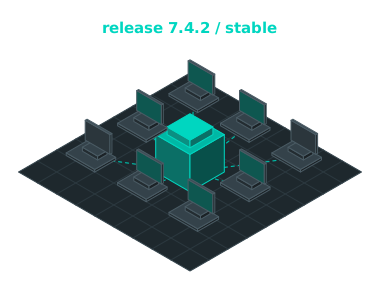
What the platform handles so your team doesn't
Update infrastructure is easy to build once and painful to run at release-day scale. These are the parts customers tell us they were glad to stop owning.

Release channels
Stable, beta, nightly and any custom channel you name. Devices follow one channel; moving a device between channels is one API call or one policy rule.
Pinning by device group
Rollback in under 90 s

Delta updates
Content-defined tiles mean a 184 MB build ships as a patch of about 10 MB on average. Devices that are too far behind fall back to a full installer automatically.
Patch depth 12 releases
Formats exe, msi, msix, pkg, dmg, deb, rpm, AppImage

Staged rollouts with a brake
Rings, percentages and schedules. A release halts itself when crash rate or failed installs move beyond the threshold you set, and tells the channel owner on Slack or email.
Ring size 0.1% steps
Hold time 5 min to 14 days

Signatures you control
Manifests carry an Ed25519 signature from a key that only you hold, optionally inside a hardware module. Devices reject anything that does not verify, including us.
Key custody vendor, HSM optional
Metadata expiry 7 days default

Delivery from 13 regions
Installers and patches sit behind a tiered cache with signed URLs, range requests and bandwidth shaping per region, so a launch in one timezone does not starve another.
Cache hit rate 98.7%
Egress ceiling none on Fleet
# Ask whether this device should update
curl -s https://nl5.enotcloud.com/api/v1/check \
  -G -d app=lumenfall-launcher \
     -d channel=stable \
     -d version=7.4.1 \
     -d os=windows -d arch=x64 \
     -d device=d_9f2c71ab
{
  "update": true,
  "version": "7.4.2",
  "delta": { "from": "7.4.1", "size": 10276044,
             "sha256": "e3b0c4...b855" },
  "full":  { "size": 193273856 },
  "ring": "broad",
  "expires": "2026-11-12T00:00:00Z"
}
# Release policy, kept in your repository
[channel.stable]
rings     = ["canary:1", "early:5", "broad:25", "all:100"]
hold      = "6h"
halt_if   = { crash_rate = 0.4, install_failure = 1.5 }
delta     = true
notes     = "RELEASE_NOTES.md"
One request decides the whole update
The Manifest API tells each device whether to update, to which version, by patch or full installer, from which ring it was assigned. Responses are signed, cacheable for up to 60 seconds, and answered from the region closest to the device.
Our last launch moved 14 PB in nine days. Nobody on the team stayed up for it.
Mara Voss, Head of Platform at Lumenfall Games, 41M devices
Read how six vendors run fleets from 1 to 41 million endpoints
Priced by devices updated, not by seats
A device-update is one successful install of one release on one device, full or delta. Failed and cancelled downloads are free. Delivery volume is included up to the limits below.
| Plan | Per month | Device-updates included | Delivery included | Support |
|---|---|---|---|---|
| Pilot | $0 | 5,000 | 2 TB | Community forum |
| Studio | $390 | 250,000 | 40 TB | Email, 1 business day |
| Fleet | $2,400 | 3,000,000 | 400 TB | Chat, 2 hour response |
| Enterprise | Custom | from 20,000,000 | from 5 PB | Named engineer, 30 minute response |
Questions we hear from release engineers
Something missing? Ask us and an engineer will answer, usually within a day.
Do we have to replace our installer?
No. Verdel hosts the installers you already build and adds an updater agent only if you want one. If you ship your own updater, call the Manifest API from it and keep the rest.
What happens if Verdel is unreachable?
Devices keep running the version they have and retry with exponential backoff, capped at 6 hours. Signed manifests are cached on the device, so a partial download resumes from the byte where it stopped.
Can we keep our own signing keys?
Yes, and we recommend it. Verdel never needs your private key; the CLI signs locally or through your own HSM. We store only the public key and the signed metadata.
How do delta updates behave on devices that skipped releases?
The manifest offers the shortest valid chain. If a device is more than 12 releases behind, or the chain would be larger than the full installer, it gets the full installer instead.
Which platforms are supported?
Windows 10 and 11 (x64, arm64), macOS 12 and later (Intel and Apple silicon), and Linux with glibc 2.28 or later as deb, rpm and AppImage.
Move your first channel in an afternoon.
Import an existing appcast or release feed, run it side by side, switch when the numbers match.