 Verdel
Release management for software that runs on someone else's computer.
Five services share one control plane: channels, delta engine, rollout controller, signing and the edge. Use all of them, or only the ones you are missing.
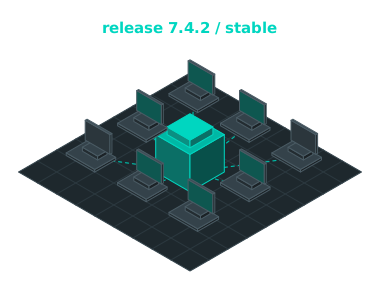
Channels and rings
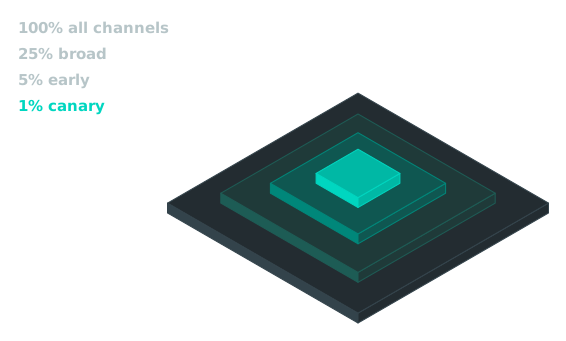
A channel is a named stream of releases, such as stable, beta or nightly. Within a channel, a release moves through rings. A ring is a slice of devices chosen by hash, by group, or both.
Default stable policy: canary 1%, early 5%, broad 25%, everyone 100%, with a six hour hold between rings. You can change ring sizes in 0.1% steps, schedule opening times in the device's local timezone, and keep enterprise customers on a slower ring with a contractual 14 day hold.
- Pin a device group to an exact version for support cases.
- Promote a build between channels without re-uploading it.
- Roll back by republishing the previous version; devices that already updated receive it as a new delta.
Delta engine, format 3
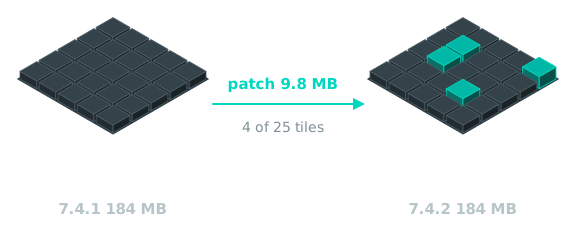
Each build is split into variable-size tiles (average 64 KB) using content-defined boundaries, so inserting a few bytes at the start of a file does not invalidate everything after it. Patches are the set of tiles a device does not already hold, compressed with zstd level 12.
| Application | Full build | Median patch | Saving |
|---|---|---|---|
| Launcher (Electron) | 184 MB | 9.8 MB | 94.7% |
| CAD suite (native) | 1.9 GB | 212 MB | 88.8% |
| Photo editor | 620 MB | 96 MB | 84.5% |
| Security agent | 58 MB | 14 MB | 75.9% |
Measured across customer releases between January and October 2026. Your numbers depend on how your build changes between versions.
Signing that does not depend on trusting us
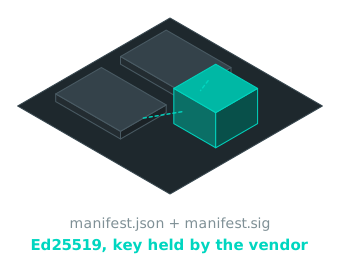
Verdel publishes metadata in four roles, in the style of established update frameworks: root, targets, snapshot and timestamp. Your root key stays offline. A targets key, held by your CI or a hardware module, signs each release. The timestamp is renewed every 24 hours so a replayed old manifest is rejected.
Devices verify the chain before they touch a download, then verify the SHA-256 of every tile as it arrives. A tampered mirror, a compromised CDN account or a malicious proxy produces a refused update, not a bad install.
Security practices and certifications · Key management guide
Installer hosting at the edge
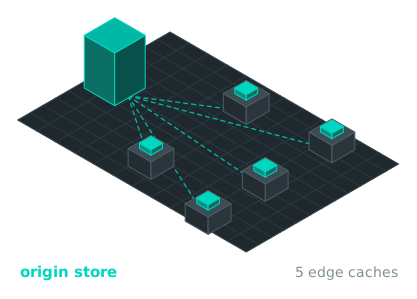
Installers, patches and symbols are stored once in an eleven-nines object store and served through a tiered cache in 13 regions. Downloads are signed URLs with an expiry you choose, support HTTP range requests, and resume across network changes.
- Peak delivery tested at 9.4 Tbps across regions.
- Per-region bandwidth shaping so one launch does not take the whole network.
- Download pages with your domain, your logo and detected platform.
- Access logs streamed to your bucket within five minutes.
What runs on the device
The Verdel agent is optional. It is a 1.4 MB Rust library with bindings for the frameworks desktop teams actually use.
| Binding | Version | Platforms | Notes |
|---|---|---|---|
| Electron | 4.12.1 | Windows, macOS, Linux | Drop-in replacement for the built-in autoUpdater |
| Qt 6 | 4.12.1 | Windows, macOS, Linux | QML module and C++ API |
| .NET 8 | 4.12.0 | Windows, macOS | NuGet package, WPF and WinUI samples |
| Swift | 4.12.0 | macOS | Swift Package, sandbox-friendly helper tool |
| C ABI | 4.12.1 | All | Header and static library for custom runtimes |